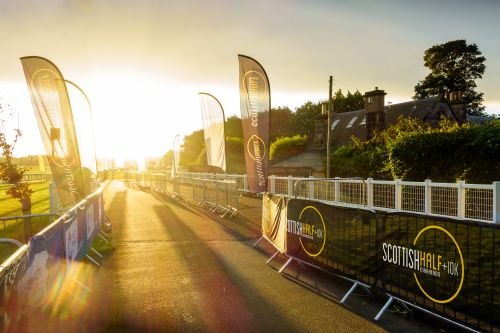
The Scottish Half Marathon is known for its fast course, East Lothian scenery and memorable finish along the final furlong at Musselburgh Racecourse. It attracts experienced runners chasing personal bests, charity fundraisers and first-time half-marathon participants. For each of them, race day represents weeks or months of training. For the team behind the event, it is the public result of an even longer planning process. The race begins at Meadowmill Sports Centre near Tranent before travelling through several East Lothian communities and finishing in Musselburgh. Delivering that point-to-point course requires an operation covering roads, transport hubs, baggage vehicles, hydration stations, medical resources and a high-capacity finish venue. The event also shares its day with the Scottish 10K. Teams must deliver two separate races while coordinating closures, volunteers and facilities across one connected programme.
Designing a Fast but Safe Course
The Scottish Half Marathon is promoted as a fast course, but favourable elevation is only part of what helps runners perform well. A safe, clearly marked route allows participants to settle into their pace without hesitating at junctions or encountering unnecessary congestion. Course planners assess the width, surface and gradient of every section. They identify where runners may bunch together, where spectators are likely to gather and where an emergency vehicle can enter or leave. The course passes through areas around Tranent, Cockenzie, Port Seton, Prestonpans and Musselburgh. Each community has different road layouts, businesses and residential access requirements. Some stretches are relatively open and exposed, while others pass through built-up areas with narrow pavements and numerous junctions. The route team determines where barriers, cones and directional signs are needed. It also identifies suitable locations for hydration points, medical resources and toilets. Accurate distance measurement is another essential task. The certified course follows a precise line, which influences the placement of the start, finish and every turn. Plans are reviewed again close to event day. Roadworks, temporary obstructions or changes in local access may require adjustments even when the route has been used previously.
Preparing Meadowmill Sports Centre
Meadowmill Sports Centre provides a practical start location, but it cannot absorb unlimited event traffic. There is no general event parking at the venue. Instead, runners and spectators are encouraged to use designated travel hubs and official buses. Before the first arrivals, the start team installs barriers, pens, toilets, timing equipment, baggage facilities and information points. Each structure has an assigned position that preserves emergency access and avoids unnecessary disruption to the surrounding area. Volunteers report for briefings and learn how the pens will operate, where to direct baggage and what to do when a participant requires a replacement number. Timing technicians test the start mats and communications equipment. Course managers confirm that every sector ahead is secure. As buses arrive, staff monitor the number of people entering the start area. A delayed service can create a sudden crowd shortly before the race, so transport coordinators remain in contact with race control. Participants move into pens according to predicted finishing times. A controlled release helps the field find space during the early miles. Once the final runners depart, the start operation begins to close. Baggage vehicles leave for Musselburgh, temporary equipment is removed and local roads are prepared for reopening.
Transport as Part of the Race Infrastructure
For the Scottish Half Marathon, event buses are not simply a convenient extra. They are a core part of the operation. Travel hubs at locations such as Newcraighall, Sheriffhall, Wallyford and Musselburgh Grammar School distribute demand across several sites. Transport planners estimate how many runners and spectators will use each hub. They schedule vehicles so participants reach Meadowmill with enough time for toilets, baggage and starting pens. Spectators may require a different journey. Some want to watch the start and then travel to Musselburgh, while others need only a return trip from a travel hub to the finish. Each ticket type must correspond with an actual transport plan. Staff at the hubs check passengers, manage queues and answer questions. Buses need routes that remain available despite race closures. Drivers receive event-specific instructions and must not rely solely on ordinary navigation systems. After the race, transport demand becomes less predictable. Faster runners may be ready to leave while later participants are still on the course. Coordinators monitor queues at the finish and communicate with vehicle operators. Delays need to be shared quickly with information teams and race control.
Building the Course Before the Runners Arrive
Course setup begins before most participants wake. Traffic-management crews install closure barriers, diversion signs, cones and parking restrictions according to approved plans. Course teams place directional arrows, kilometre markers, hydration-station signs and other participant information. Every turn is inspected. A single missing or badly angled arrow could cause confusion, particularly when runners are moving quickly. Surface checks identify debris, standing water, potholes or unexpected obstructions. Problems are removed, marked or escalated. Hydration teams receive water, tables, waste containers and instructions about how supplies should be presented. Medical locations are prepared, and access routes are checked to ensure vehicles can reach them after closures take effect. Sector managers confirm that their areas are ready. Race control does not rely on assumption; it needs positive confirmation that the course is secure.
The Volunteers Across East Lothian
Volunteers are stationed on open roads, village streets, junctions, hydration points and the racecourse approach. Each role requires a specific briefing. Course marshals learn the direction runners will approach, where spectators may cross and how local access arrangements should operate. Hydration volunteers prepare tables and distribute water to a field that may arrive in concentrated waves. They need to replenish stock without stepping into the path of runners. Discarded bottles create a slip hazard, so waste is collected throughout the race rather than left until the end. Volunteers also provide encouragement. This is especially valuable on quieter coastal stretches, where participants may be struggling without large crowds. A marshal may be the first person to see that someone is unwell. Volunteers use radios or agreed contact procedures to report the participant’s condition and precise location. They do not replace medical professionals, but their observations allow help to be dispatched quickly. Supervisors check volunteer welfare, provide updates and confirm when each position can close. No marshal should leave simply because the main pack has passed.
Medical Planning Across 13.1 Miles
A half marathon requires medical preparation for a wide range of possible incidents. The team considers expected runner numbers, course geography, weather forecasts and historical information from previous events. Fixed treatment points are supported by mobile responders and vehicles. Their positions are selected according to risk and access. The course’s exposed sections can magnify weather conditions. Warm sunshine may increase dehydration, while coastal wind and rain can contribute to cold stress. Medical teams prepare for muscle injuries, trips, breathing difficulties, dehydration and serious cardiac incidents. Marshals reporting a problem need to provide an exact location. The name of a road, nearby junction or assigned course position is far more useful than a vague description. Race control tracks which medical resources are available. If one team becomes committed to an incident, the controller knows what coverage remains elsewhere. Medical planning continues at the finish. Participants who stop after sustained effort may become dizzy, confused or unusually cold. Finish volunteers are trained to call for assistance rather than assuming someone simply needs to sit down. The objective is to identify developing problems early while maintaining the ability to respond to a major emergency.
Race Control Across Multiple Closure Zones
The road plan is divided into operational sectors or zones. Each sector has a manager or responsible team reporting readiness, runner progress and incidents to race control. The control room tracks the leading runners, main field and final participants. These positions inform medical readiness, finish preparation and the phased reopening of roads. An issue in one community can affect much more than the immediate location. A blocked junction could delay event buses, restrict medical access or disrupt residents elsewhere. Race control considers the event as one connected system. Radio communication uses agreed call signs and location references. Messages need to be concise so urgent information is not lost in unnecessary conversation. Weather updates, transport reports and finish capacity are monitored throughout the race. Significant incidents and decisions are logged. This record is essential for reviewing the event accurately after everyone has gone home.
Working With East Lothian’s Communities
The Scottish Half Marathon depends on cooperation from the communities through which it passes. Road closures affect residents, businesses, public transport and people who may have no connection to the race. Advance communication explains closure times, parking restrictions and any special access arrangements. Businesses may need alternative delivery plans, while residents with care, work or travel commitments need to understand how the event will affect them. On race day, marshals protect the course while responding to questions. The role requires patience as well as firmness. A secure closure cannot be relaxed because someone is in a hurry, but legitimate access needs still deserve professional handling. Parking is a particularly sensitive issue. Vehicles blocking driveways, pavements or bus routes can create serious problems. An obstructed pavement affects wheelchair users and families with buggies. A badly parked car can prevent an event bus or ambulance from passing. Enforcement teams and marshals monitor restricted streets. Vehicles causing serious obstruction may be removed. Protecting local access is essential to maintaining the support that allows the race to return.
The Musselburgh Racecourse Finish
Musselburgh Racecourse provides the Scottish Half Marathon with its defining image: runners completing their final effort along the finishing furlong. Transforming the venue into a high-capacity finish requires careful planning. Timing mats, cameras, barriers and signage are installed and tested. The course entry must remain clear, and runners need enough space to decelerate after crossing the line. Volunteers keep participants moving towards medals, hydration, nutrition and baggage collection. The layout follows a deliberate sequence. If one area becomes congested, the queue could travel backwards towards the timing line. Spectators are separated from the operational finish and directed towards reunion spaces. Families cannot enter the funnel to meet a runner, even when they can see them nearby. Medical routes remain open at all times. Clinicians need to reach a participant quickly without pushing through crowds. The racecourse has already hosted the Scottish 10K finish earlier in the day. Supplies and systems must be reset before half-marathon runners arrive.
Baggage From Start to Finish
Every correctly tagged bag handed over at Meadowmill must reach Musselburgh before its owner. Baggage volunteers arrange bags by number and load them into assigned vehicles. The vehicles follow planned routes that avoid the race and closures. The schedule includes contingency time for traffic delays. At the racecourse, bags are unloaded and displayed in numbered sections. Signage helps runners reach the correct collection point. Volunteers handle problems such as damaged tags, misplaced bags and unclaimed belongings. The service becomes especially important in poor weather. A runner may need warm, dry clothing immediately after finishing. Baggage collection must therefore be efficient without blocking participant flow through the venue.
The Sweep and Road-Reopening Operation
The strict event timetable includes a sweep operation following the back of the field. The sweep team monitors the final participants and communicates their location to race control. Medical, marshal and hydration coverage remains in place while official participants continue through each section. After the final runner passes, course-clearance crews begin collecting signs, cones and waste. Roads cannot reopen until equipment is removed and the surface is safe for traffic. Traffic-management teams lift closures in an approved sequence. Opening one junction too early could direct vehicles into a sector where runners remain. Hydration stations collect bottles and remaining stock. Marshals stay until their supervisor confirms they can leave. The process gradually returns East Lothian to normal while protecting the final participants as carefully as the leaders.
The Work After the Final Furlong
For runners, crossing the line marks the end of the Scottish Half Marathon. For the delivery team, several hours of work may remain. Timing data is checked, medical reports completed and lost property recorded. Contractors remove barriers, toilets, signage and technical infrastructure. Radios and volunteer equipment are returned. Baggage teams reconcile unclaimed items, while transport coordinators continue working until the last scheduled buses depart. The racecourse, Meadowmill and the course are inspected before being formally handed back. Managers then begin the post-event review. Transport figures show whether bus capacity matched demand. Medical reports identify incident patterns, while timing data reveals how the field moved through the course. Volunteer feedback highlights practical concerns at individual locations. Residents and local partners may identify access or communication issues. Even a successful event generates lessons for the next year.
The People Behind Every Personal Best
The Scottish Half Marathon’s reputation for speed is partly created by its flat course, but it also depends on an operation that removes obstacles before runners encounter them. Participants can focus on pacing because the turns have been marked, roads protected and hydration delivered. Their baggage is waiting because volunteers and drivers moved it across East Lothian. Medical help is available because teams mapped every access route in advance. The final furlong feels celebratory because staff built a finish system capable of receiving thousands of tired runners safely. Behind every personal best, charity achievement and first half-marathon medal is a team working across travel hubs, village streets, radio networks and the racecourse. Their success is measured not only by what runners notice, but by the complexity they never have to see.